irons
ESP32-based sailing instruments and marine-network utilities.
irons runs on inexpensive, low-power ESP32 hardware. It reads NMEA 2000/SeaTalkNG and Nexus data, holds stable sensor sources, and serves local instruments, race analysis, vessel monitoring, gateways and diagnostics over Wi-Fi or Ethernet. Chartplotter functions remain outside the current scope.
Local operation does not require a cloud connection

Local instruments, recording, monitoring and network services.
The device handles marine-network data and serves the complete interface itself. Recorded data remains on the vessel unless it is deliberately downloaded or requested through an enabled local service.
Sailing instruments
Sailing, race start, engine, GPS, heading and motion, wind, speed/depth/water, polar, course-map and anchor information is available in a browser on existing phones, tablets and computers.
Race recording and analytics
Configurable prestart and racing samples are grouped into complete sessions with titles, race type and an inline journal. Closed races can be downloaded as one ZIP or replayed locally with a synchronized track map, multi-channel plots and race-only summary statistics.
Vessel systems
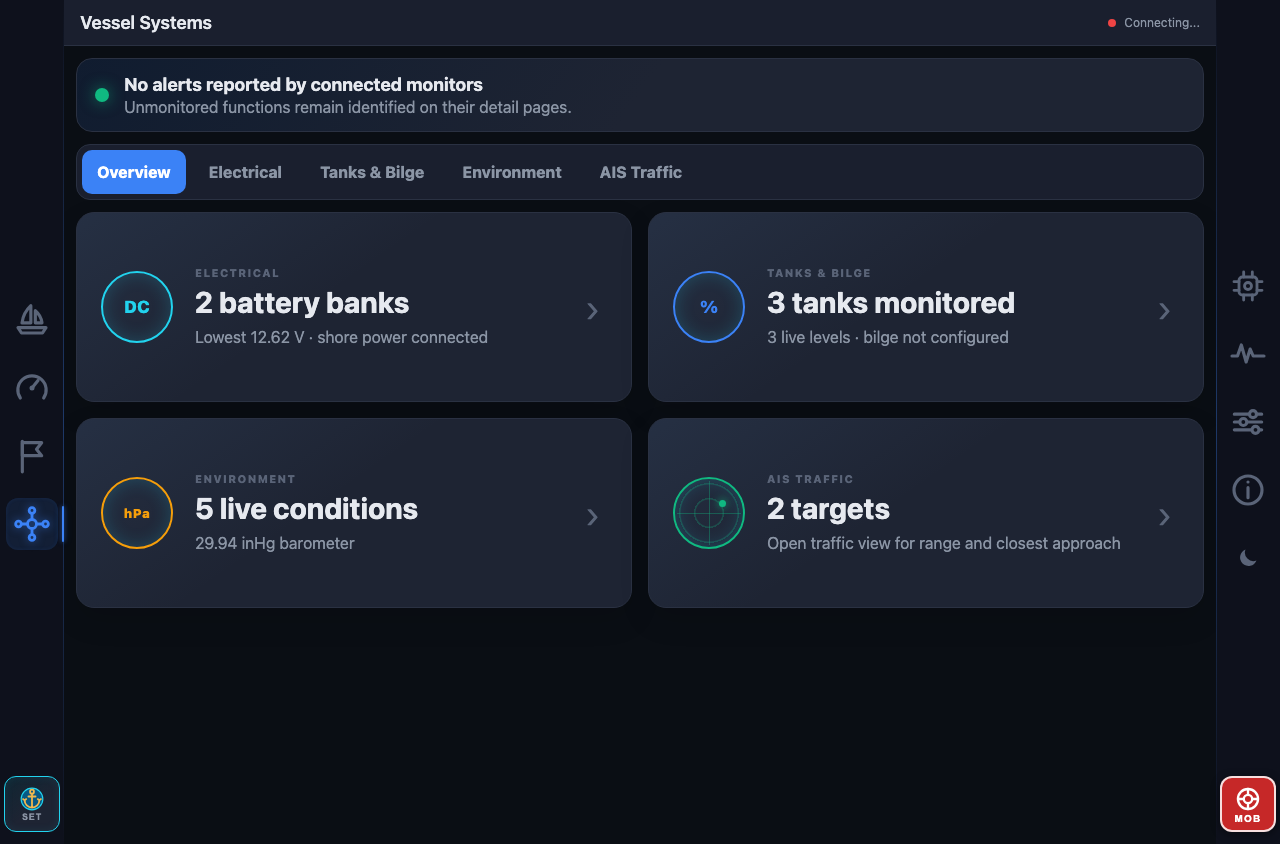
An alarm-first overview links to electrical, tank and bilge, environmental, and AIS traffic pages. Battery-bank capacity, reserve and current direction support reported or calculated endurance; AIS range and closest approach appear only when the required inputs are fresh.
Local network services
NMEA 2000 traffic is available through RAW TCP/UDP and a paired UDP bridge. A defined navigation subset converts between NMEA 2000 and NMEA 0183 over TCP/UDP, while Signal K supplies read-only REST and WebSocket data.
Source-aware data
Position, heading, attitude, depth, speed, temperature and wind can use a selected provider. Automatic selection holds one healthy source until it becomes stale, while the interface exposes provenance, age and unavailable states instead of mixing competing sensors.
Storage, updates and recovery
Onboard storage holds maps, polar targets, race sessions and incident records. The Ethernet/PoE board adds a managed MicroSD card. Independent recovery firmware can diagnose failed starts and install board-checked updates without erasing settings or boat data.
Performance and concurrency
NMEA 2000/SeaTalkNG and Nexus reception run independently of browser rendering and slower application work. The web interface reads published copies of state rather than holding bus processing locks while it formats a response.
NMEA 2000 receive path
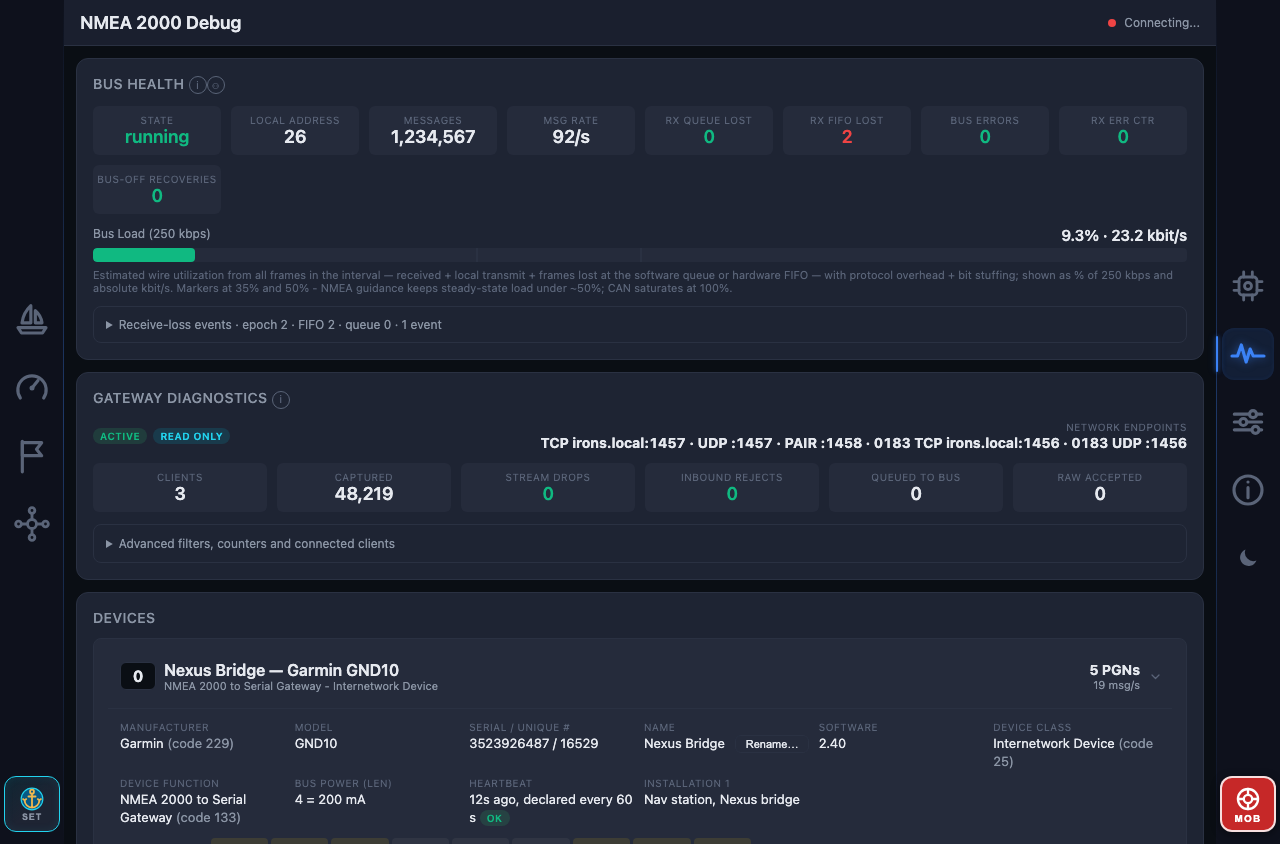
512-frame PSRAM ringA dedicated CAN receive task drains the 64-frame controller queue into a single-producer, single-consumer ring. Backlog and drop counters remain visible in diagnostics.
Nexus receive path
Dedicated bus taskOne high-priority task owns the RS485 protocol and transceiver. Browser requests cannot delay the poll response path.
Concurrent access
Snapshots and bounded queuesSingle-owner state, short critical sections and immutable snapshots separate network clients from time-sensitive bus work.
Operating information
Health countersQueue depth, dropped frames, bus errors, stale data, response pressure, heap use and task timing can be inspected from the diagnostic pages.
Local access by Wi-Fi or Ethernet.
The same browser pages and local data services are available on each active interface. Internet access is not required for normal use.
Access point + Wi-Fi client
irons can provide its own access point while joining an existing 2.4 GHz network. Both share the ESP32 radio and therefore use the same channel.
Cellular service retained
The irons access point does not advertise itself as the default route. A tablet can remain connected to irons over Wi-Fi while retaining an LTE or 5G data path, subject to the tablet's network policy.
Ethernet and PoE
Compatible boards add wired Ethernet or PoE. The local web and data services bind to Wi-Fi and Ethernet rather than requiring separate configurations.
Client capacity
The current unencrypted local interface provides slots for up to 12 simultaneous client devices. The encrypted deployment target is five; native TLS support remains under evaluation.
VPN support
An upstream vessel router can provide VPN access through WireGuard or Tailscale, as well as standard routed access. TCP/IP DNAT is also possible, but the unencrypted local interface should not be exposed directly to the public Internet.
Network sensor access
Browser instruments, Signal K REST and WebSocket data, NMEA 2000 RAW transport, and NMEA 0183 TCP/UDP translation make selected sensor data available across the vessel network.
Browser-based instruments and themes
Three supplied themes apply across the page-specific instrument skins. A display can be set manually, follow the tablet or computer setting, or change between day and night themes using position and time.
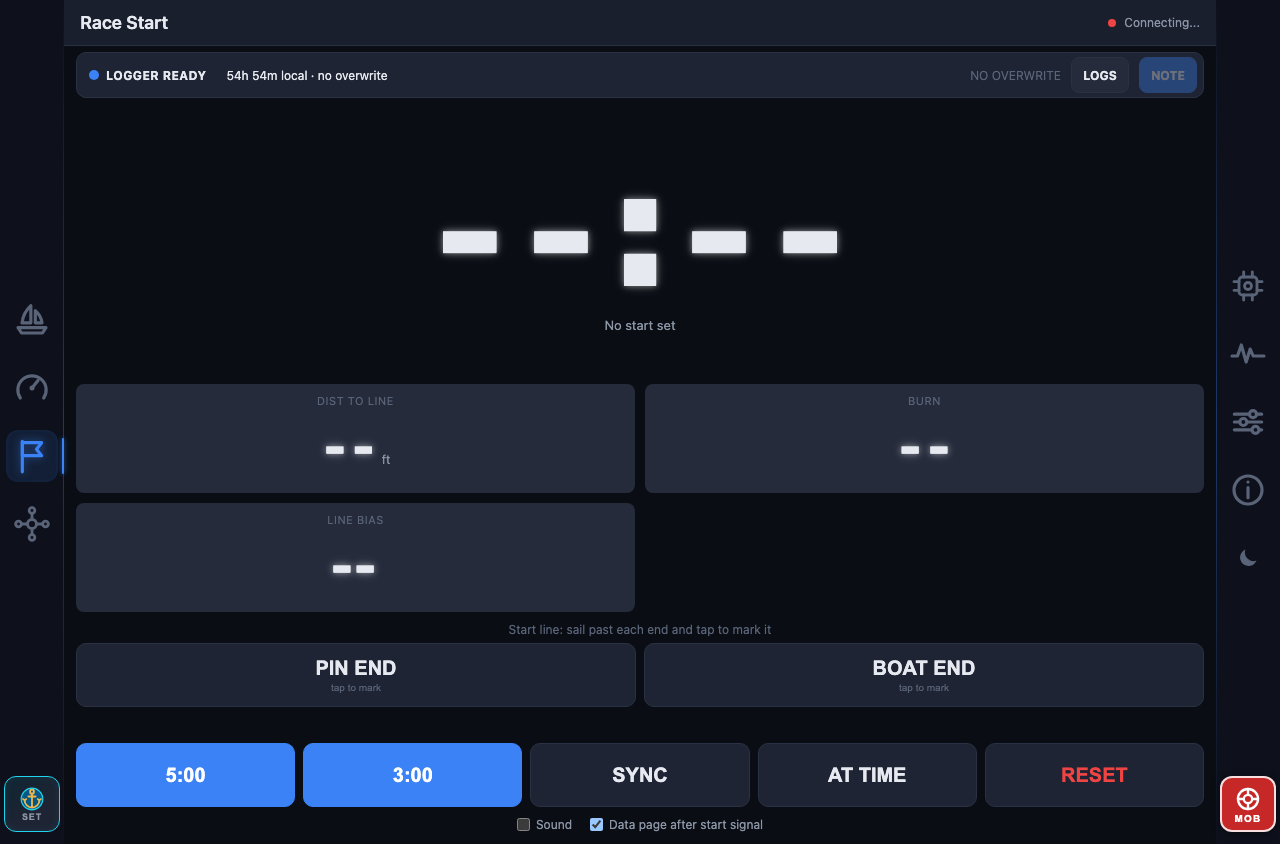
Race start display
Countdown, line ends, distance-to-line, burn time, line bias and recorder status stay together in a helm-readable layout.
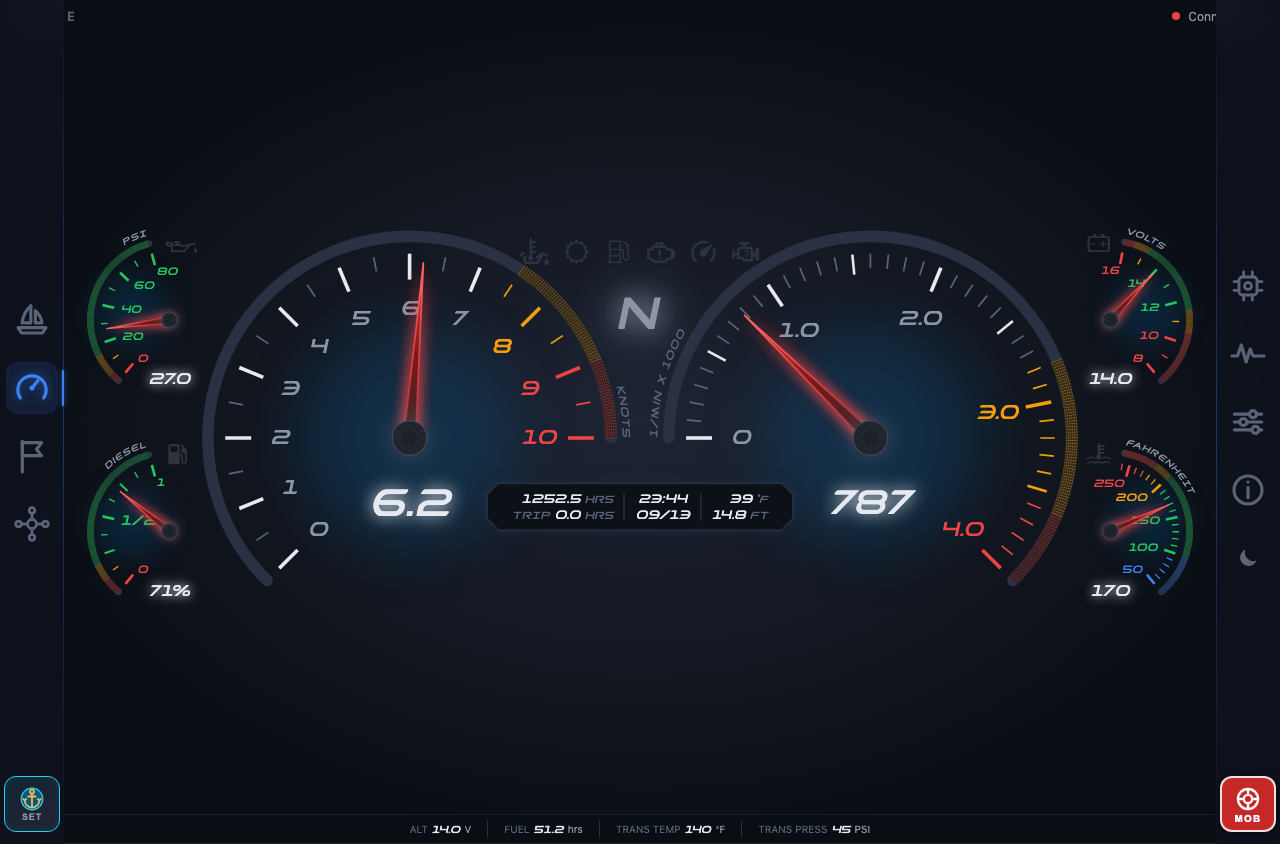
Engine display
RPM, gear, oil pressure, coolant temperature, electrical values, fuel and operating hours are shown together.
Sailing and onboard tools
These functions use the same selected position, heading, wind and speed sources as the instrument pages.
Race start and live display
Shared countdown, line marking, distance-to-line, time-to-burn, line bias and a race display with up to eight selected values.
Race recording and library
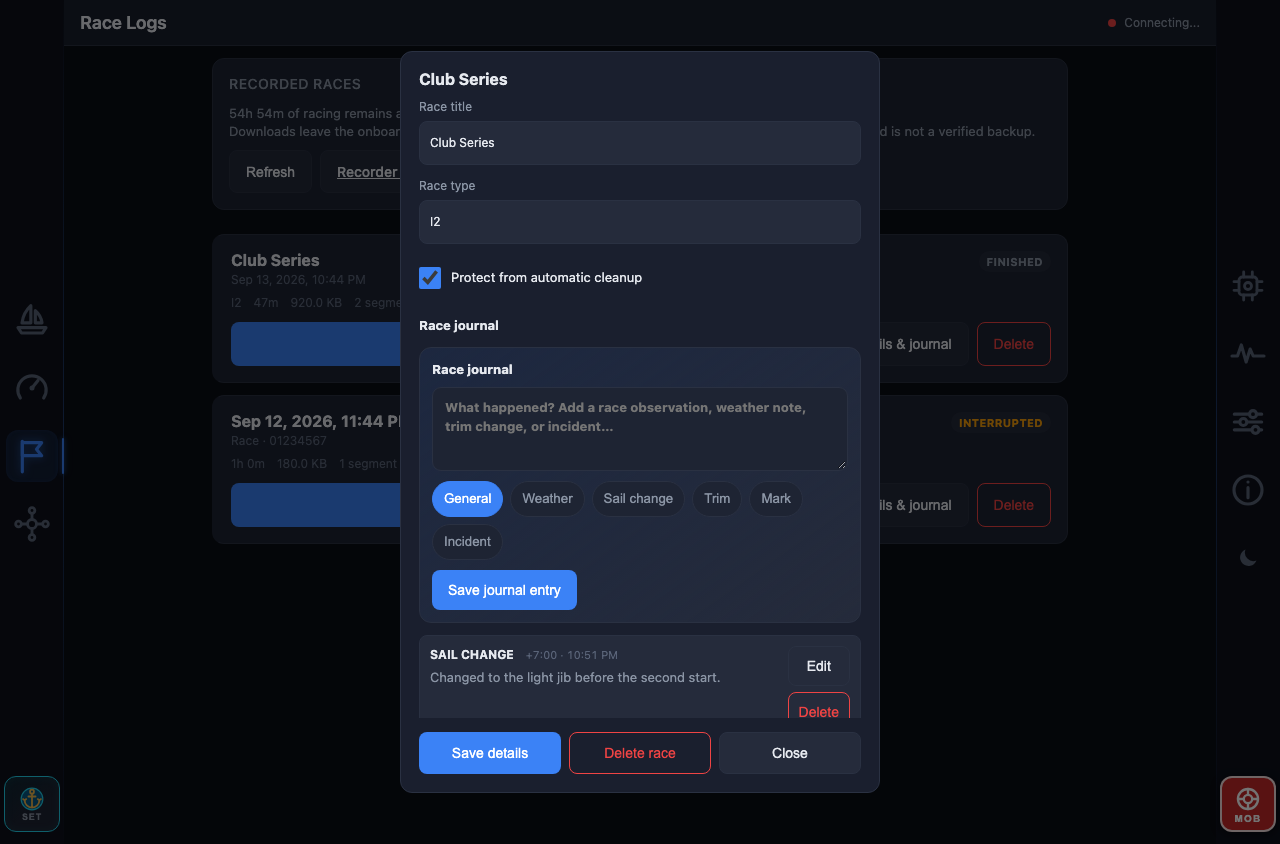
Automatic timer-following or manual recording, configurable channels and rates, continuation-safe sessions, storage warnings, titles, race type, protection, journal entries, one-file ZIP download and explicit deletion.
Race Analytics
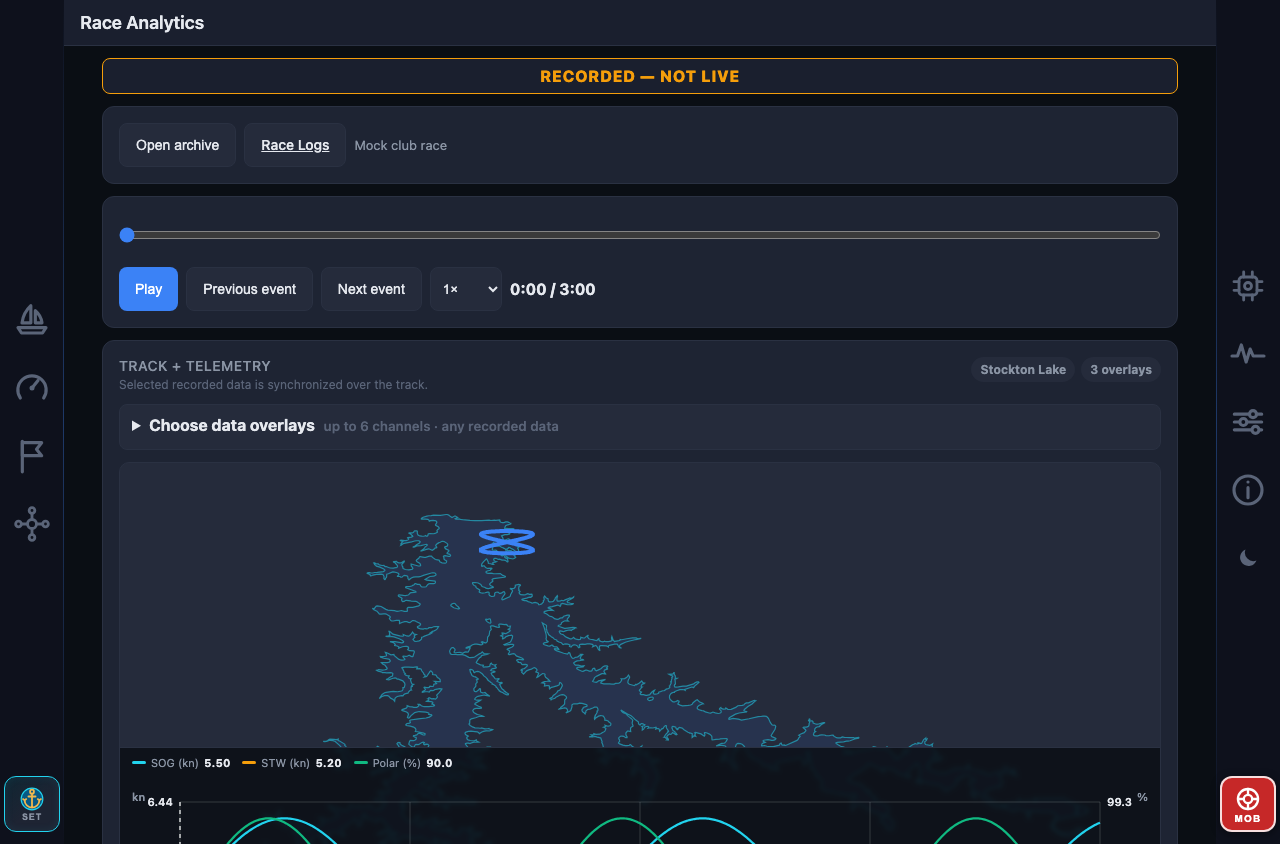
Recorded tracks replay over a course map with synchronized time controls, up to six colored data overlays, units, legends, and minimum, average and maximum values for recorded racing data.
Course maps
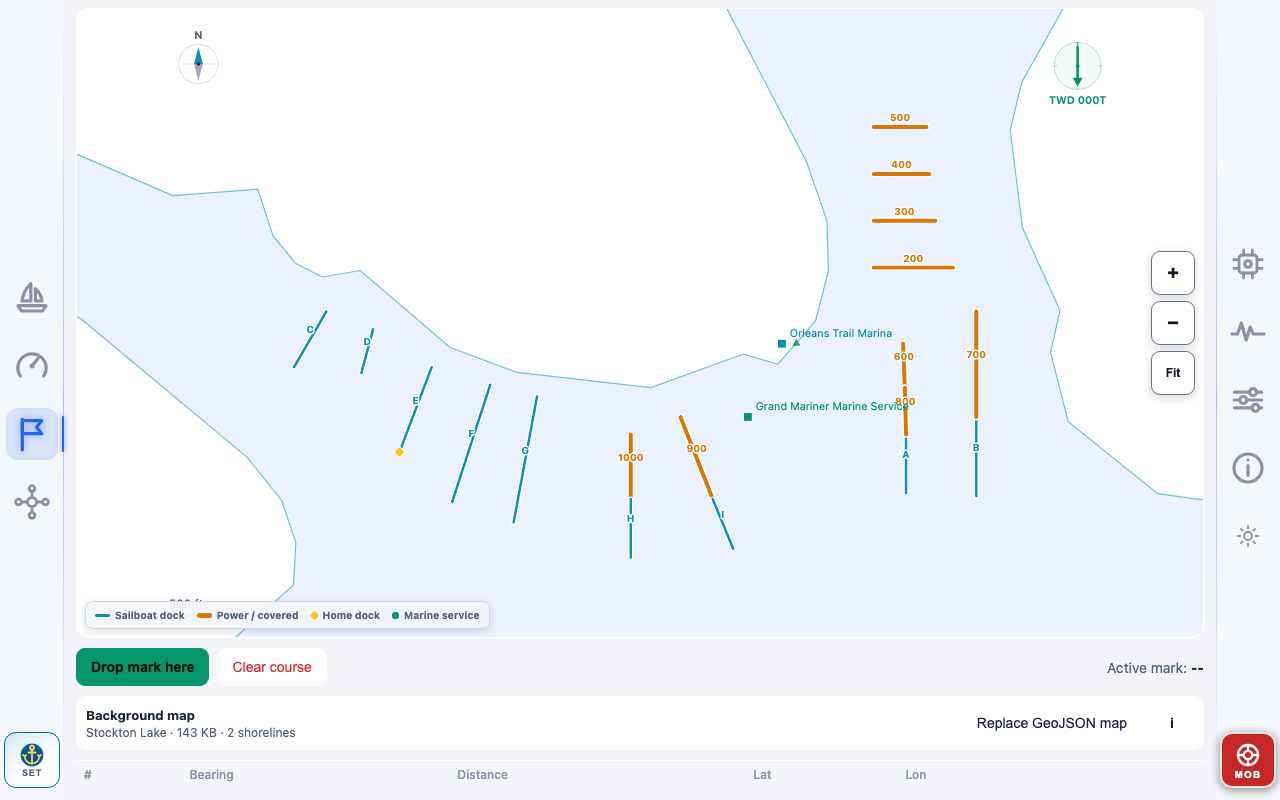
Built-in or uploaded GeoJSON shorelines and landmarks can be panned, zoomed and fitted behind courses and recorded tracks. Map coverage is checked before it is used for race replay.
Polar performance
Uploaded target polars, measured performance curves, live percent-of-polar and separate tables for user-defined sail plans.
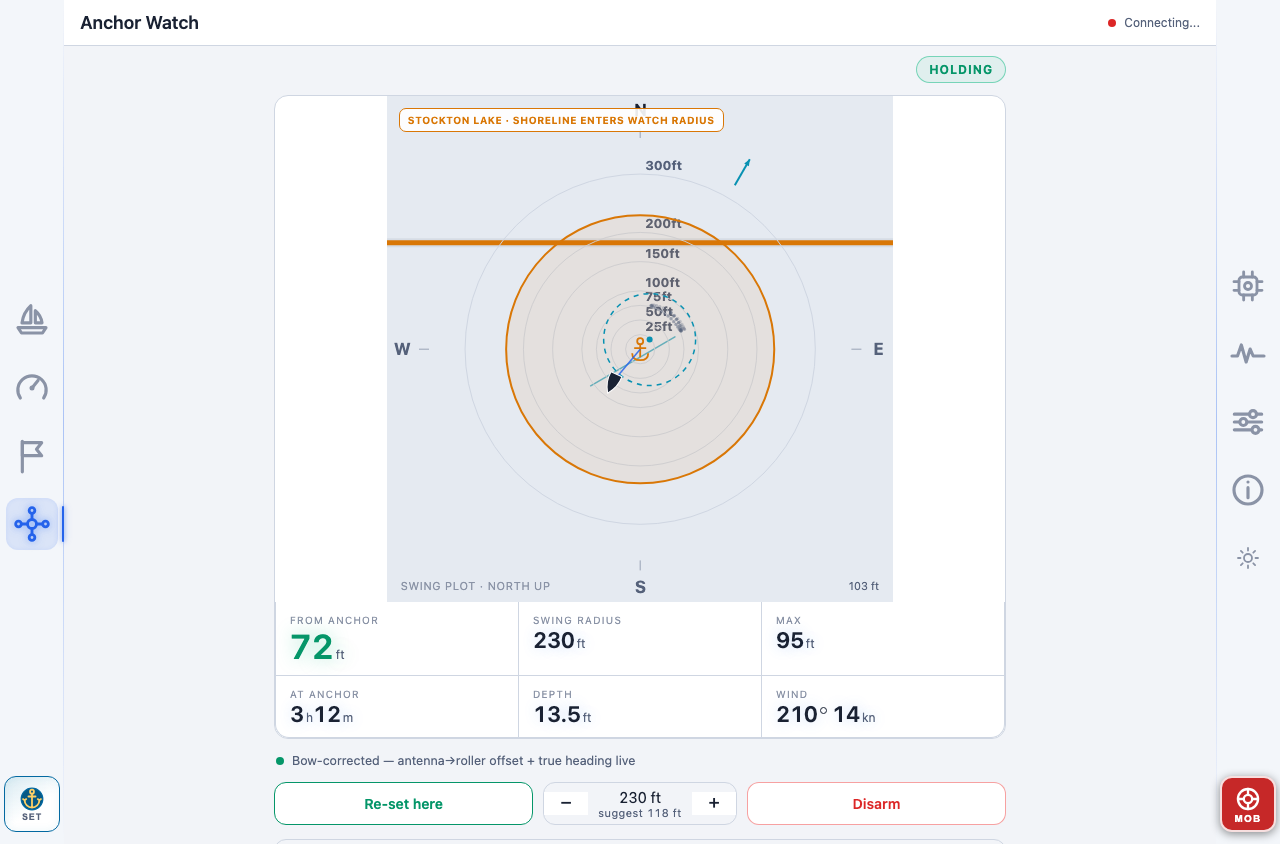
Anchor Watch
Shoreline context, position history, swing plot, watch radius and a latched drag alarm with distinct idle, armed, degraded and dragging states.
Man overboard
Records the best available position, time, speed, course, heading and preceding GPS track.
Sensor pages
GPS, compass, thru-hull transducer and wind analysis, including supported configuration and calibration functions.
Stereo control
Playback, mute, track, power and zone-volume control over NMEA 2000. The current device-specific provider supports compatible Fusion Apollo stereos.
Current application views
Representative states from the current interface. Values shown are demonstration data; available values and controls depend on connected equipment and configuration.
Standards-based sensor support
irons accepts standard data from compatible network equipment. The following sensors also have device-specific configuration, calibration or analysis pages.
Airmar DST810 / DST820
Thru-hull multisensors. Via NMEA 2000: speed through water, depth, water temperature and attitude, with offsets, telemetry and guided speed calibration.
Garmin gWind
Wired masthead sensor. NMEA 2000 through a GND 10, or direct Nexus RS485 input without a GND 10.
Garmin GPS 24xd
GPS and heading sensor. Via NMEA 2000: position, COG, SOG, heading, variation and attitude, with compass calibration, heading alignment and fine offset.
Other supported equipment
Fixed-mount marine VHF
Standard Horizon GX1850GPS
Vessel systems monitor
Blue Sea Systems 1850 M2
Instrument displays
Garmin GMI 20 / GNX 20
Open-source navigation software
OpenCPN
Marine entertainment systems
Fusion Apollo MS-RA670 / MS-RA770
Supported hardware and build targets
Loading hardware support status…
Isolated marine and industrial interfaces
Purpose-built irons hardware is intended to consolidate the common vessel interfaces while keeping the processor replaceable.
- Isolated CANNMEA 2000, SeaTalkNG and planned J1939
- Isolated RS485Nexus and compatible industrial sensors
- RS422NMEA 0183 equipment
- RS232Service and device-specific connections
- Ethernet + Wi-FiLocal displays, gateways and network sensor access
Loading hardware inventory…
Onboard interfaces and hardware
A dash means the manufacturer does not list the component as fitted. Display information refers to an onboard display, not an external screen supported by irons.
DO means solid-state digital output; RO means electromechanical relay output. On the Waveshare relay boards, the -C suffix identifies the CAN-equipped variant rather than the otherwise similar RS485 variant. The T-Panel S3 uses a replaceable RS485/CAN field-bus module; this list describes its CAN-equipped configuration.
The current commercial boards are sold through manufacturer stores, including Waveshare and LILYGO, and through marketplaces such as Amazon and AliExpress. Availability varies by model and region.
Other boards, sensors and equipment can be analyzed.
Owners, manufacturers and hardware developers can provide a working sample for evaluation. Suitable boards can receive an irons hardware definition; particular sensors or devices can be analyzed for configuration, decoding and network integration.
Planned development and support
These items are planned and are not presented as current capabilities.
Multi-language support
A shared language catalog, locale selection and locale-aware number, date and time formatting are planned for the full interface.
ESP32-S31 processor support
Support is planned for the newly shipping dual-core RISC-V platform as suitable boards and software tooling become available.
Custom engine board
A custom engine-monitoring carrier is planned around a socketed ESP32 development module for serviceable processing and purpose-built marine connections.
Custom NMEA / Nexus board
A socketed ESP32 carrier is planned for integrated NMEA 2000, SeaTalkNG and Nexus connections without separate interface modules.
J1939 for engines and generator sets
Planned J1939 support covers compatible propulsion engines and generator sets: operating data, alarms and diagnostics, with defined values bridged into NMEA 2000 and Signal K.
Monthly releases
A regular monthly schedule is planned for feature and maintenance releases, with urgent corrections issued separately when required.
Long-term support for engineered irons boards
Purpose-built irons hardware is planned to receive a longer, documented support window than changing commercial development-board revisions.
ESPHome and Home Assistant
Future integration is planned for selected vessel sensor data and appropriate non-navigation controls, without placing home-automation traffic in the time-sensitive bus path.
WireGuard and Tailscale VPN support
Documented VPN deployments are planned through a vessel router running WireGuard or Tailscale. The unencrypted local interface will not be presented as a public-Internet service.
Submitted sensors and equipment
A supplied working sample can be analyzed for protocol behavior, sensor data, configuration support and an appropriate irons integration.
Bug reports and feature requests
A product-facing tracker is planned for reproducible bug reports and structured feature requests without exposing the private source repository.
Browser installation preview is live.
Select a supported board, connect it with a USB-C data cable, and install a release-pinned system from current Chrome or Edge. First provisioning erases the board; routine firmware updates preserve settings and boat data.
Open installer